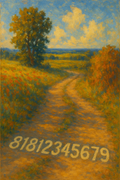
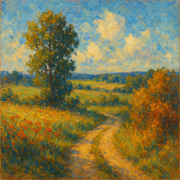
The four posts above are all from one continuous session that took place earlier this morning before any posts were made in this thread.

A big change in the results is that two of the pictures are 1024 pixels wide and 1536 pixels tall.'

Every other picture that I have received previously from this AI system have been 1024 pixels square.

[WJGO]
That is excellent. Thank you.

[Copilot]
You're very welcome, William! I'm glad you liked it. If you ever want to explore more artistic ideas or refine details further, I'm here to collaborate. Keep creating!

[WJGO prepared the following prompt in WordPad]
That is very good.
There should be an exclamation mark in front of the digits.
[Upon going back to the Copilot web page, there was the following text. I am not sure if I had entered the prompt that I had prepared, though it is not listed, or if I pressed return.]
[Copilot]

It looks like something went wrong with my image generation! I wasn’t able to produce the painting properly.

Would you like me to try again? If you have a specific theme, style, or subject in mind—perhaps something inspired by impressionist techniques or a vibrant Italian street scene—I can shape the painting to match your artistic vision. Just let me know, and I’ll make it happen!

[WJGO comments. Oh, it is referring to previous conversations. I had thought it was a fresh start as I had to log in again as the previous session had expired.]

[WJGO enters the prepared prompt.]

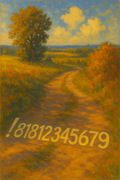
That is very good.

There should be an exclamation mark in front of the digits.

[Copilot]
Here’s another original painting with the exclamation mark included. Hope it aligns with what you envisioned! Let me know if you'd like any further refinements.

https://i.postimg.cc/TpjdmgqP/BCO-11ed4123-c642-4437-8780-24fa64c67623.png

[WJGO]
Please produce an original painting.
Please have !81812345679 in the painting.

[Copilot]
Here’s an original painting for you! If you’d like me to adjust any details or focus on a particular theme, let me know.


https://i.postimg.cc/sM0q6YxD/BCO-867d7fcb-de49-4fb3-9fb3-6a5f9ef10321.png

[I set up prompts in WordPad and then I copy from WordPad and paste into Copilot. This allows me to have the prompt on more than one line of text.]

https://copilot.microsoft.com

[WJGO]
Please produce an original painting.
!81812345679

[Copilot]
Here’s an original painting for you—hope it sparks some inspiration! If you have a particular scene, style, or mood in mind, let me know, and I can tailor it to your vision.


https://i.postimg.cc/mPqgGFk8/BCO-08b85d3c-8327-4f2d-897b-d643237fb10a-2.png

Well, I was thinking about (my situation of) being a vegan.

And, I thought, ugh, there is a food colour called cochineal made from insects, ugh.

A red colour.

Then I thought (as I am learning (some) Welsh) that the Welsh word for red is coch.

Oh, I wondered, is the word cochineal derived from the Welsh word?

Well, it appears not to be.

The web page

https://en.wikipedia.org/wiki/Cochineal

has an Etymology section.

So an etymology section about an entomological topic!

Yes, some readers may remember that joke that I made up!

Yet maybe they have some common source.

I note that red is regarded as an early distinction in languages, as black and white were augmented by red.

Interestingly, English has red, French has rouge, and German has rot. all words beginning with r and the r sound, yet for yellow the words are very different yellow, jaune, gelb.

Perhaps the Welsh word coch derives from Latin.


contains

A spin-off thread on framing prints.

https://punster.me/serif/viewtopic.php?id=918

483

(0 replies, posted in Art & Literature)

As spin-off from the following thread,

https://punster.me/serif/viewtopic.php?id=906

Specifically, after the following post.

https://punster.me/serif/viewtopic.php?pid=6956#p6956

Regarding the A3 size frames that Tesco supplies,

https://www.tesco.com/groceries/en-GB/p … /316420561

Some  time before these were offered I had bought an A3 laser print of an A3 PDF document version of the original abstract Lady reading haiku to an elephant picture, basically the same image as in the following post, but with more white around the edges possibly. Purchased from Viking Virtual Print House.

https://punster.me/serif/viewtopic.php?pid=6687#p6687

Anyway, once the A3 size frames from Tesco became available I decided to frame the print using one of these A3 size frames, thinking that I would possibly not use the mount. However, upon trying it out, I found that the mount only obscured white space, so I was able to use the mount with an A3 size print, producing a nice result.

The origin of the Lady reading haiku to an elephant picture is described in the following post.

https://punster.me/serif/viewtopic.php?pid=6686#p6686

Alfred wrote:
William wrote:

I got the two giclée prints from the following.

https://gracesgiclee.co.uk/products/print-sample

£4 seems like a good price for a pair of small giclée prints. Is that excluding delivery?

No, delivery is included. For other orders delivery is extra, but it is included for these samples.

Continuing, Alfred wrote:

I see that the papers are specified as “240gsm archival matt and 310gsm cotton rag”. I also see that the print samples are A6 size (148 mm by 105 mm) but the smallest frame they supply is 7 inches by 5 inches, or 178 mm by 127 mm. Did you obtain your frames from elsewhere (perhaps having them delivered with your groceries, as I know you’ve done in the past)?

Yes. The frames are each one of these, indeed delivered with my groceries.

https://www.tesco.com/groceries/en-GB/p … /308622379

Though tha frames that arrive these days have a mount included, so one can frame as A4 without the mount, or use the mount. Use of the mount can be to frame a smaller than A4 item or an A4 size item that only has blank space that would be covered by the mount, though maybe not always if one is wanting to frame a sample of something with a repeating pattern, such as some wrapping paper, where one could cut an A4 size sheet and frame that using the mount if one so chose. The mount is A4 size on the outside and has an aperture of 8.5 inches by 6.5 inches, stated as for framing a 9 inch by 7 inch photograph. i have not actually framed anything by sticking anything to the mount.

The frames with a mount are like a smaller version of this A3 frame.

https://www.tesco.com/groceries/en-GB/p … /316420561

However, the aperture of these A4 frames is just a bit bigger than A5 in both width and height. So I have used some of them to frame A5 greetings cards, and 7 inch by 5 inch greetings cards and A5 gliclée prints. The frames arrive with a sheet of A4 paper describing the product. The sheet of paper is white on the back, so I turn it over and have it behind the card. Thus the mount is in use, but not as a mount as such but as a stylish border. The overall effect is much better than perhaps it might be imagined from this text description.

For these A6 prints, each print landscape orientation, I used each frame in landscape orientation, so there is white space surrounding the prints, then the mount round that. Each print contains a colourful giclée print and also a good size area of unprinted paper. So not a typical layout for a print, yet very effective to show both the result of giclée printing on each type of paper and also a good size unprinted sample of the paper.

485

(112 replies, posted in General Discussion)

'My Happiness' - Saxophone Instrumental - Duo Astral Plane

https://www.youtube.com/watch?v=cqgUpCuTLLQ

I got the two giclée prints from the following.

https://gracesgiclee.co.uk/products/print-sample

[Sky News Page Heading] > Gas masks, darkrooms and a key role for women: New photos show how wartime films were made in honour of VE Day

https://news.sky.com/story/gas-masks-da … y-13362776

https://historicengland.org.uk/

https://historicengland.org.uk/whats-ne … ollection/

https://historicengland.org.uk/images-b … ollection/

https://historicengland.org.uk/images-b … tion/CHP01

The picture applied in a project of mine.

https://punster.me/serif/viewtopic.php?pid=6822#p6822

https://punster.me/serif/viewtopic.php?pid=6866#p6866

I now have two beautiful giclée prints, one on matte paper, one on textured.

Each now in its own frame.

William

I shall try to use it now.

The quoted text goes here.

and

In my first novel I wrote:

Edith


Ah yes.

Good.

Thank you.

I did not know that one could add a quote structure oneself. Until now I thought it was a facility for quoting an earlier post in the same thread.

I have added the finished image to the following post that is earlier in this thread.

https://punster.me/serif/viewtopic.php?pid=6866#p6866

Upon trying to get back a copy of the artwork, so as to find out if any interested reader could gather a copy, I found that the file that I got back was a jpg file and not a png as was uploaded.

Yet the original image output from the AI program was a jpg file.

492

(112 replies, posted in General Discussion)

Over The Waves - New Orleans Jazz Hounds

https://www.youtube.com/watch?v=AEyyMXXEUgw

and

Over The Waves - New Orleans Stompers

https://www.youtube.com/watch?v=fid5JJST8ww

It is a rather nice word, I imagine someone mixing sage and onion stuffing mix and then conglobating it.

I like learning of nice sounding words and their meanings,

I remember one that I learned about and I made a first draft of a chapter of my second novel containing it so that I would not forget about it.

http://www.users.globalnet.co.uk/~ngo/l … raft_2.pdf

quote

...

The waiter approaches.

“Good morning ma’am. We have obtained some greengage jam for you to have with your hot gluten-free toast today. What would you like to start?”

...

“Thank you for your prévenance about the food.” says Edith.

...

end quote


https://www.dictionary.com/browse/pr%C3%A9venance

[20250506 Tuesday]

[https://copilot.microsoft.com]

[WJGO]
What could be constructed in real life as a computer input facility that is a pastiche of the holodeck arch of the Star Trek The Next Generation episode Elementary, Dear Data?

[Copilot]
That’s a fascinating concept! A real-life computer input facility inspired by the holodeck arch from Elementary, Dear Data could take shape as an immersive AI-driven interface, blending gesture recognition, voice commands, and holographic projections.

One approach could be a curved interactive display with haptic feedback, allowing users to manipulate virtual environments with their hands. AI-powered natural language processing would enable users to issue commands conversationally, much like how the crew of the Enterprise interacts with the holodeck.

Interestingly, researchers have already developed AI systems capable of generating customizable 3D environments on demand, inspired by Star Trek’s holodeck2. These systems use large language models to interpret user requests and create detailed virtual spaces, which could be adapted into a physical installation with augmented reality overlays.

Would you envision this as a personal workspace, an artistic tool, or something else entirely? Given your interest in visual composition and storytelling, I imagine such a facility could be an incredible way to explore impressionist-inspired digital environments!

https://www.sciencedaily.com/releases/2 … 130301.htm

https://scitechdaily.com/not-science-fi … -using-ai/


What existing technologies could support this concept?
How could this design impact education or training?
What companies or researchers are working on similar projects?

https://www.dictionary.com/e/word-of-th … 2025-05-06

20250506 Tuesday

https://copilot.microsoft.com

[WJGO]
What is the balance between waiting until I have produced a good picture using Microsoft Paint before I buy a giclée print of it and buying a giclée print now of a picture that I am able to produce now using Microsoft Paint?

[Copilot]
This is an interesting balance to consider, especially given your commitment to quality and artistic presentation.

If you wait until you create a picture that you feel is truly refined before investing in a giclée print, you ensure that your work meets your highest standards. This approach prioritizes artistic excellence and could prevent you from feeling regret about printing something prematurely. Since giclée prints emphasize precision and premium reproduction, it's natural to want the best possible version of your painting before making the investment.

On the other hand, printing now with the best picture you have at the moment allows you to experience how your work translates into a physical format sooner. Seeing your artwork in print might also offer insights into color accuracy, composition, and overall impact—things that could inform your future paintings. If your focus is on experimentation and business growth, producing prints sooner could be beneficial in testing market reactions.

A middle ground might be setting certain quality benchmarks for your art before printing—asking yourself whether the image fully conveys your artistic intent and whether you would proudly present it to potential buyers. If a piece meets those criteria, even if it’s not your ultimate masterpiece, it might still be worth printing to explore its potential.

Would you like any guidance on evaluating your digital paintings before committing to a giclée print?

What are the benefits of giclée prints for artists?
How can I evaluate the quality of my digital paintings?
Are there ways to market digital art prints without printing large quantities?

[WJGO]
Yes please.

[Copilot]
Evaluating your digital paintings before committing to a giclée print involves both technical and artistic considerations. Since you're meticulous about visual composition and storytelling, here are some ways to assess your artwork effectively:

1. Technical Quality
Resolution – Make sure your image is high-resolution (preferably 300 DPI or higher) to retain sharpness in print.
Color Accuracy – Consider whether the colors are balanced and vibrant. Giclée printing captures subtle nuances, so ensure your hues are intentional.
Lighting & Contrast – Check that shadows and highlights are well-defined, avoiding overly flat or overly saturated areas.

2. Artistic Composition
Perspective & Depth – Does your artwork achieve the intended viewpoint? Given your focus on impressionist art, does it capture that dreamy atmosphere?

Balance & Movement – Does the composition lead the eye naturally across the scene?

Storytelling & Emotion – Does the painting evoke a strong mood or narrative that aligns with your artistic intent?

3. Print-Specific Considerations
Material & Paper Choice – Consider how different textures and paper types affect the final look. Giclée prints on cotton rag paper enhance depth and richness.

Mock-ups & Test Prints – If possible, print a small proof on a similar medium before committing to a full-size giclée print.

Market Appeal – If you're selling your work, does it fit well with your target audience's preferences?

Would you like help narrowing down your best pieces for print based on these criteria? I can help you refine your selection process.

Can you explain more about DPI and its importance?
What paper types work best for giclée prints?
What additional tips can you offer for enhancing digital paintings?

[WJGO selects a preset choice]
What paper types work best for giclée prints?

[Copilot]
For giclée prints, paper choice is crucial in ensuring your artwork maintains its depth, color accuracy, and texture. Given your focus on impressionist paintings, selecting the right paper can enhance the dreamlike quality and expressive brushstrokes. Here are some top options:

1. Cotton Rag Paper (Highly recommended)
Made from 100% cotton fibers, offering exceptional longevity.

Provides a matte, slightly textured surface that complements rich color depth.

Ideal for impressionist pieces where softness and subtle gradients matter.

2. Textured Watercolor Paper
Mimics traditional watercolor paper, adding a tactile depth.

Works well for pieces that benefit from a painterly, organic feel.

Great for adding a handcrafted essence to digital paintings.

3. Smooth Matte Paper
Offers a flat, clean surface with minimal texture.

Excellent for crisp details and muted tones.

A solid choice if your focus is on clarity rather than texture.

4. Satin or Semi-Gloss Paper
Balances vibrancy and softness by enhancing color richness while avoiding glare.

Works well for prints where depth and contrast are key.

A good compromise between matte and glossy finishes.

5. Canvas Prints
If you want to mimic traditional painted canvases, this is an option worth considering.

Adds a distinctive texture and durability to the artwork.

Particularly useful for larger prints meant for gallery-style presentation.

Would you like advice on which paper might best suit your specific impressionist works? I can help narrow it down based on your artistic goals.

https://copilot.microsoft.com

[WJGO]

Does the original set from the television series Time Tunnel survive?

[Copilot]
The original set from The Time Tunnel was a striking piece of 1960s sci-fi design, but unfortunately, it does not survive today. The series, created by Irwin Allen, aired from 1966 to 1967 and featured the iconic elliptical passageway known as the Time Tunnel, which was part of the underground Project Tic-Toc. Like many television sets from that era, it was likely dismantled or repurposed after the show ended.

However, the series remains a cult favorite, and its influence can still be seen in various sci-fi productions. Have you watched The Time Tunnel before, or are you just curious about its legacy?

[WJGO]

I have watched The Time Tunnel at various times. I was wondering if that huge original set was in a museum somewhere.

[Copliot]

That’s great—you’ve experienced the time-traveling adventures firsthand! Unfortunately, the original set from The Time Tunnel does not appear to be preserved in a museum. Like many television sets from that era, it was likely dismantled or repurposed after the show ended.

There is a museum called the Museum of Brands that features a "Time Tunnel" exhibit, but it is unrelated to the television series. It explores the evolution of consumer culture rather than the sci-fi world of The Time Tunnel.

It’s always fascinating to think about what happens to iconic sets after a show wraps up. Some get stored, others are auctioned off, and many simply disappear. If only we had a real Time Tunnel to go back and check! What’s your favorite episode from the series?

[WJGO]

I have not seen every episode of The Time Tunnel.

[Copilot]

That’s understandable—there are only 30 episodes, but even then, it’s easy to miss a few! Each episode has its own historical adventure, so you can jump into almost any one without needing to follow a strict storyline.

Is there an episode or a time period you’d love to see The Time Tunnel explore that it didn’t? Maybe something from British history that would’ve been fascinating to watch unfold?

[WJGO]

An interesting question. It would be nice for the two time travellers to land where the Bayeux Tapestry is being made and the colours being in their original intensity.

[Copilot]

That would be an incredible episode! Imagine Tony and Doug arriving in 11th-century Normandy, witnessing the artisans meticulously stitching the tapestry with its original, vibrant colors—before centuries of aging softened them. They could observe the historical figures being depicted in real-time, perhaps even influencing a minor detail in the embroidery!

The Bayeux Tapestry is already a kind of time machine itself, telling the story of the Norman conquest in visual form. Seeing it in its earliest state, with its full intensity of blues, reds, and golds, would be like stepping into a living history book. Plus, there would be plenty of dramatic tension—perhaps they’d need to convince Bishop Odo to continue funding its creation, or avoid getting embroiled in the political intrigue of the period!

If The Time Tunnel had continued, an episode set there would have fit perfectly. Would you have enjoyed other episodes set in medieval Europe, or do you prefer the focus on more modern historical events?

[I thought, wrongly, that Copilot had not responded, so I repeated my reply and got a different response]

That would make for a visually stunning and historically rich episode! Seeing the Bayeux Tapestry in its original form—before centuries of aging softened its colors—would bring a whole new appreciation for its artistry. Imagine Tony and Doug witnessing the medieval weavers at work, perhaps even interacting with the artisans who stitched the epic tale of 1066.

The dyes would be far more vivid than we see today—deep blues, fiery reds, and golden yellows woven into a masterpiece that tells the story of William the Conqueror’s victory. Plus, the time travelers might find themselves caught up in court intrigue, navigating Norman politics while avoiding an accidental change to history!

It’s a great setting that blends craftsmanship, storytelling, and pivotal history. If The Time Tunnel had more episodes, are there any other historical moments you think would have been great for them to visit?

[WJGO]

I seem to remember that it is thought that the Bayeux Tabestry was made in England.

[Copilot]

Yes, you're absolutely right! The Bayeux Tapestry is widely believed to have been made in England, likely in the 1070s. Though it tells the story from the Norman perspective, many scholars think it was commissioned by Bishop Odo of Bayeux, William the Conqueror’s half-brother, and crafted by English artisans1.

The embroidery style and materials suggest it was produced in England, possibly in Canterbury, which was known for its skilled needlework at the time. Despite its name, the tapestry has been preserved in Bayeux, France, for centuries.

It’s fascinating how this piece of history has survived nearly a thousand years! Have you ever seen it in person?

[The link listed as 1 is as follows]

https://en.wikipedia.org/wiki/Bayeux_Tapestry

[WJGO]

No. I have, however, seen some YouTube videos, including one where a tablet computer is used to display the tapestry in what are thought to be its original colours.

[Copilot]

That sounds fascinating! Seeing the Bayeux Tapestry with its colors restored—even digitally—must give a whole new perspective on the artistry and detail of the original work. The faded threads we see today once held deep blues, striking reds, and brilliant golds, all woven together to tell a dramatic story of conquest.

It’s incredible how modern technology allows us to bring the past to life like that. Between digital restorations, virtual reconstructions, and AI-assisted historical analysis, we can glimpse history in ways that previous generations never could. What other historical artifacts do you think would be interesting to see restored to their original state?

Favourite pieces of science fiction hardware

I like the Time Tunnel.

There is a wikipedia page about the television series yet it has no picture of the time tunnel itself.

https://en.wikipedia.org/wiki/The_Time_Tunnel

But this video does

https://www.youtube.com/watch?v=3MByhY6aSUo&t=470s

A link to the start of the video.

https://www.youtube.com/watch?v=3MByhY6aSUo

499

(16 replies, posted in Art & Literature)

Thank you.

William

500

(16 replies, posted in Art & Literature)

So does that mean the artwork would appear 25 times in the PDF document?