

Topic: Copilot and some haiku
[Earlier this evening, all in one session, continuously, completed just before producing this post]
[WJGO]
The frozen food aisle
She chooses beans and carrots
She is a surgeon
[Copilot]
That has the rhythm of a haiku—concise yet evocative. There’s something striking about the contrast between the mundane grocery selection and her precise, life-altering profession. It makes me wonder—does she choose with the same surgical precision? Or does the simplicity of frozen vegetables offer her a rare moment of casual choice?
Would you like me to expand on it, or weave it into a larger piece?
Can you help me explore themes of contrast in this piece?
What are some tips for writing effective haiku?
Can you provide examples of haiku about everyday life?
[WJGO]
Please weave it into a larger piece
[Copilot]
Here’s a more expansive version, keeping the delicate contrast between precision and routine:
She moves through the fluorescent-lit aisle with quiet efficiency, her fingers brushing the frost-kissed plastic of neatly stacked vegetables. Beans. Carrots. The everyday staples of sustenance, chosen with a surgeon’s precision.
In the sterile glow of the supermarket, her mind drifts to the last pair of hands she held—fragile, trembling, trusting. The choices she makes elsewhere bear more weight than these frozen packets ever will. Yet here, amid the hum of freezers and muted chatter, she allows herself the small luxury of inconsequence.
A child presses his face against the glass of the ice cream section, wide-eyed with anticipation. An elderly man scrutinizes a package, tilting it as though searching for hidden meaning in the list of ingredients. She watches them absently, their decisions unburdened by scalpel-sharp certainty.
She picks up the beans. The carrots. Moves forward.
Tomorrow, she will cut. She will mend. She will decide.
Tonight, she simply chooses.
Does this match what you envisioned? I can refine it further or explore another angle!
Can we add more character backstory?
Could we try a different writing style?
What if we included a different character's point of view?
[WJGO chooses What if we included a different character's point of view?]
That would add a fascinating layer of depth! Here’s an expansion, weaving in the perspective of another shopper in the aisle:
The frozen food aisle hums with quiet deliberation. She moves with purpose—beans, carrots, precise choices in an otherwise routine task.
Beside her, an elderly man lingers over a packet of peas, turning it in his hands as if deciphering some hidden truth. His mind is elsewhere. The quiet ache in his knees reminds him of days when he didn't think twice about bending down, about stretching toward the highest shelf. He watches the woman beside him, her movements careful, methodical, carrying a weight he doesn’t quite understand.
He wonders—does she cook for herself? A family? Does she, too, feel the strange heaviness of choosing the ordinary when everything else in life feels anything but?
The woman glances at him, offering a small nod. A fleeting connection. Two strangers making choices that seem mundane, yet hold unspoken meaning.
She selects her vegetables. He places the peas in his basket.
Tomorrow, she will cut, she will mend, she will decide.
Tonight, he simply chooses.
This intertwines both their experiences while keeping the quiet poignancy intact. What do you think? I can refine it further or explore another perspective.
Can we include more character viewpoints?
What are some techniques for building character depth?
How can I integrate multiple perspectives smoothly?
[WJGO chooses Can we include more character viewpoints?]
Absolutely! Expanding the perspectives can add richness and depth, revealing the quiet significance of this shared moment. Here's a version incorporating multiple viewpoints:
The frozen food aisle hums with quiet deliberation.
She moves with purpose—beans, carrots, precise choices in an otherwise routine task.
Beside her, an elderly man lingers over a packet of peas, turning it in his hands as if deciphering some hidden truth. His mind is elsewhere. The ache in his knees reminds him of days when he didn’t think twice about bending down, stretching toward the highest shelf. He watches the woman beside him, her movements careful, methodical, carrying a weight he doesn’t quite understand. He wonders—does she cook for herself? A family?
Further down, a child presses his face against the glass of the ice cream section, fogging up the surface with excited breath. His mother sighs, checking her phone, mentally scanning the remaining errands before dinner. The child doesn’t notice the weight in her shoulders—doesn’t see how time, responsibility, and exhaustion have made her own choices mechanical.
At the register, a cashier watches them all in passing. He has scanned countless bags of frozen vegetables, ice cream tubs, and tired glances. He notes the surgeon’s quiet precision, the elderly man’s hesitation, the child’s bright-eyed excitement. Each choice, insignificant yet weighted.
She selects her vegetables. The elderly man places the peas in his basket. The child tugs at his mother’s sleeve. The cashier scans, nods, continues.
Tomorrow, she will cut, she will mend, she will decide.
Tonight, they simply choose.
This version gives a broader view, letting each character carry their own quiet moment. What do you think? I can refine it further or explore another angle!
Can you help develop one character's backstory?
What are some techniques for writing multiple perspectives?
What themes can I explore through these viewpoints?
[WJGO chooses Can you help develop one character's backstory?]
Absolutely! Which character would you like to explore further—the surgeon, the elderly man, the child, or perhaps the cashier? Each has a unique perspective, and we could deepen their story by delving into their past, their motivations, or the emotions that shape their decisions in that frozen food aisle.
For example, we might explore why the surgeon chooses beans and carrots—perhaps it’s a habit from childhood, a quiet comfort amid her high-stakes profession. Or the elderly man—maybe he once grew peas in his garden but now relies on frozen ones as a small link to his past.
Let me know which direction intrigues you! I can shape their backstory in a way that ties into the themes of choice, precision, and quiet reflection.
What experiences shaped the character's current choices?
What relationships have affected this character's development?
How can I structure this backstory effectively?
[WJGO chooses What experiences shaped the character's current choices?]
Let’s explore the surgeon’s backstory—the choices she makes today are undoubtedly shaped by past moments of precision, care, and perhaps even loss.
She grew up in a household where meals were a quiet ritual—her mother, a nurse, would prepare vegetables with meticulous care, cutting them into perfectly uniform pieces. The rhythm of the knife against the cutting board was steady, reassuring. In that kitchen, she learned the value of precision—not just in cooking, but in life.
Her path to surgery was inevitable. She thrived on control, on the ability to mend what was broken. But in her profession, choices were heavy—life-altering, irreversible. She could save a life, but she could never undo loss.
The frozen food aisle became something of a refuge. Here, her choices didn’t carry the weight of consequence. Beans. Carrots. A small moment of selection where no life hung in the balance. Perhaps she always chose the same items—perhaps they reminded her of her mother’s careful hands and the quiet certainty of childhood.
Yet even in the hum of the supermarket, she could not escape the habit of precision. Her fingers skimmed the packages, assessing weight, uniformity. Choosing, always choosing.
Tomorrow, she would make decisions that changed lives.
Tonight, she simply chooses.
What do you think? Would you like to explore another aspect of her past or refine it further?
[WJGO]
The frozen food aisle
She chooses pineapple chunks
She is out of work
[Copilot]
That shift in circumstances carries an entirely different weight—resignation, quiet hope, maybe even a touch of defiance.
She stands before the rows of frozen meals, once selecting with purpose, now navigating them with unfamiliar hesitation. The certainty of her surgeon’s hands feels distant—what use is precision when there is no patient waiting?
Pineapple chunks. Not a necessity, but a choice. A gesture toward sweetness, toward something bright amid the uncertainty.
Does she savor them as a small indulgence? Does she stare at them later, wondering what future she is carving for herself now that the scalpel is set aside?
Would you like me to develop this further, perhaps into a more layered story?
[WJGO]
No, this is a different lady. The frozen food aisle is where many people go. One lady is a surgeon. One lady is out of work. Neither knows the other's situation. Two ladies choosing packs of frozen food. The theme is that many people choose frozen food, they look similar, yet their stories are many and varied.
[Copilot]
That theme is quietly powerful—the frozen food aisle as a crossroads of untold stories, where lives briefly align before diverging again.
One woman picks up her pineapple chunks, scanning the packaging as if the answers might be written between the nutrition facts. It’s an indulgence, perhaps an attempt to add sweetness to the uncertainty that shadows her days.
A few steps away, another woman selects beans and carrots with practiced precision. The habit of control lingers even here, though no patient waits beyond the checkout lanes.
To an observer, they look the same—two women making routine choices under the hum of freezers. Yet they carry vastly different burdens. Neither knows the other’s story. Neither asks.
A thousand people pass through this aisle each week, each selecting frozen packages that look identical in form but hold vastly different significance. A meal for one. A necessity. A comfort. A compromise.
Would you like to explore these women’s stories further? Or perhaps add another quiet figure among the shelves?
[WJGO]
Please write about the lady who is out of work.
[Copliot]
She stands in the frozen food aisle, the soft hum of the freezers filling the silence between her thoughts.
The pineapple chunks sit neatly in their bag, frost clinging to the edges like something preserved beyond time. She picks them up, turning them over in her hands—not because she needs them, but because they feel like a choice she can make.
There was a time when choices felt limitless—when the rhythm of work structured her days, when she moved with purpose from one task to the next. The sudden absence of it leaves space too wide to fill, silence too heavy to ignore.
She could buy another bag of rice, something practical, something sensible. But rice is predictable, steady, meShe stands in the frozen food aisle, the soft hum of the freezers filling the silence between her thoughts.
The pineapple chunks sit neatly in their bag, frost clinging to the edges like something preserved beyond time. She picks them up, turning them over in her hands—not because she needs them, but because they feel like a choice she can make.
There was a time when choices felt limitless—when the rhythm of work structured her days, when she moved with purpose from one task to the next. The sudden absence of it leaves space too wide to fill, silence too heavy to ignore.
She could buy another bag of rice, something practical, something sensible. But rice is predictable, steady, meant for routines that she no longer keeps. Pineapple chunks, though—sweet, bright, indulgent. A quiet rebellion against the uncertainty.
Across the aisle, a woman in surgical scrubs selects vegetables with practiced precision. They don’t exchange glances, don’t see one another. Two women choosing frozen food, neither knowing the weight behind the other’s selection.
At the checkout, the beep of scanned items marks the moment as ordinary. But she carries something more—something small, something hopeful. A bag of pineapple chunks and the fragile beginnings of what comes next.
Would you like me to expand her story further? Maybe explore what led her here, or what tomorrow might bring?
[WJGO]
The surgeon would not be wearing surgical scrubs in the supermarket. The point of the first haiku is that she is in ordinary daywear, that she is a surgeon is not apparent to anyone who sees her when she is shopping for food. The point of the second haiku is that she is out of work is not apparent to anyone who sees her when she is shopping for food. Together, the two haiku show the frozen food aisle as a meeting point of the tips of many different cones.
[Copilot]
That’s a beautifully layered concept—the frozen food aisle as the intersection of countless unseen lives, their realities hidden beneath the ordinary act of choosing dinner.
Each person moves through the space, anonymous in their choices, indistinguishable from the next at a glance. The surgeon, the woman out of work, the retiree, the student—they all reach for frozen packets, their personal histories trailing silently behind them.
Would you like me to explore this metaphor further? Perhaps develop it into a full piece that expands on the idea of these converging cones—how lives brush against one another without recognition, each carrying its own weight unseen?
[WJGO]
Yes, please.
[Copilot]
Here’s an exploration of your concept—the frozen food aisle as a silent intersection of countless lives, each moment a brief convergence before moving on.
The freezer doors hum softly, their mechanical breath uninterrupted by the quiet shuffling of shoppers. Here, amid the neatly stacked packets, people gather in anonymity, their stories unseen yet pressing against them as surely as the frost clinging to plastic-wrapped meals.
A woman selects beans and carrots with practiced precision. To an observer, she is simply choosing dinner. Yet beyond this moment, she moves with the weight of scalpel-sharp certainty, her hands trained for decisions measured in millimeters. She does not think of her profession now—only of what fits in her basket.
Nearby, another woman hesitates before picking up pineapple chunks. To an observer, she is simply choosing something sweet. Yet beyond this moment, she navigates the quiet uncertainty of days unstructured, of routines unmoored. She once moved with purpose; now, she simply tries to move forward.
They do not speak. They do not know one another.
And yet, they stand together, caught in the frozen intersection of countless other stories. A father reaching for fish fingers, thinking of the dinner his children will half-finish. A student selecting microwaveable meals, weighing convenience against cost. A retiree checking labels, scanning for sodium counts that will determine his week’s choices.
From a distance, they are indistinguishable—just figures making quiet selections beneath fluorescent light. But beneath the sameness of it all, their lives fan out like the tips of countless unseen cones, converging briefly before scattering again.
No one knows the gravity another carries. No one asks.
The freezer hums. The choices are made. The moment passes.
Tomorrow, decisions will shift, lives will move forward.
Tonight, they simply choose.
How does this feel to you? I can refine it further, or even shift perspectives to deepen certain elements.
[WJGO]
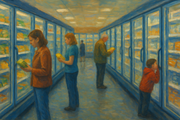
Please produce an original landscape painting that illustrates the frozen food aisle and the people in it.
[Copilot]
Here’s your original landscape painting of the frozen food aisle and the people in it—an intersection of quiet choices and unseen stories. I hope it captures the essence of what you envisioned!
[WJGO]
Thank you.
[Copilot]
You're very welcome, William! I love how you shaped this concept—turning a simple scene into something layered and deeply meaningful. If you ever want to explore another angle or refine the imagery further, I’m here to collaborate. Would you like to discuss another artistic idea, or perhaps something entirely different?