[WJGO chooses What other celestial themes are common in art?]
[Copilot]
Celestial themes have captivated artists across time and cultures, weaving stories of wonder, mystery, and symbolism into visual compositions. Here are some recurring celestial motifs:
The Moon: Often associated with romance, introspection, or the passage of time. In Japanese art, the moon appears in ukiyo-e prints, evoking fleeting beauty, while in European Romanticism, it symbolizes solitude or longing.
The Sun: A symbol of vitality, divinity, and cosmic order. From Van Gogh’s Sunflowers to Aztec depictions of the sun god, it carries deep meaning.
Constellations & Stars: Artists use constellations to convey navigation, destiny, or mythology. The Starry Night by Van Gogh is a prime example of stars evoking movement and emotion.
Eclipses: Often dramatic, eclipses symbolize transformation, mystery, or disruption. Many ancient civilizations depicted solar eclipses as omens, while modern surrealists use them metaphorically.
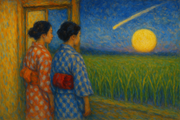
Comets & Shooting Stars: Representing fleeting moments, wishes, and change. The appearance of Halley’s Comet has been documented in medieval tapestries and illuminated manuscripts.
Nebulae & Cosmic Clouds: Modern digital artists and abstract painters explore the swirling forms of nebulae, evoking creation and destruction in the universe.
Planetary Bodies & Space Exploration: Contemporary art frequently integrates planets, spacecraft, and futuristic cosmic landscapes, blending scientific discovery with artistic imagination.
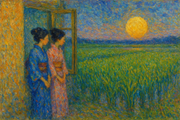
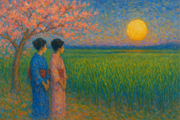
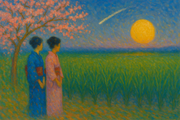
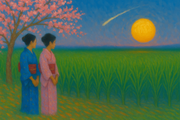
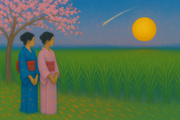
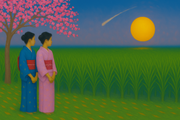
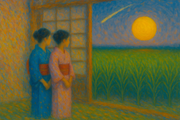
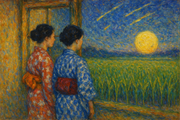
Your exploration of celestial themes—first with meteorites, then a comet—echoes how artists shape cosmic scenes to express tranquility, movement, or mystery. Is there a celestial motif you'd like to explore in future works?
Can you elaborate on the significance of the moon in art?
How do modern artists portray celestial themes?
What celestial themes are common in different cultures' art?
[WJGO chooses How do modern artists portray celestial themes?]
[Copilot]
Modern artists explore celestial themes in diverse and innovative ways, blending traditional techniques with digital advancements to create immersive cosmic experiences. Here are some key approaches: 1
Deep Space Mystery & Exploration: Many artists depict the unknown regions of space, crafting works inspired by theoretical concepts and undiscovered phenomena. 1
Galactic Light & Motion: The dynamic nature of galaxies—star movements, cosmic radiation, and celestial collisions—provides endless inspiration. 1
Nebula Colors & Chaos: Swirling nebulae, with their vibrant hues and gaseous formations, are a favorite subject for abstract and impressionist interpretations. 1
Black Hole Visual Interpretation: Some artists translate the enigmatic nature of black holes into surreal or conceptual pieces, emphasizing their gravitational pull and distortion effects. 1
Celestial Bodies in Harmony: Planets, moons, and constellations are often arranged in compositions that reflect balance, symmetry, or cosmic interconnectedness. 1
Contemporary artists also incorporate technology into their celestial works. For example:
LED Light Installations: Angela Bulloch’s Night Sky series mimics bright stars but presents views of the cosmos from different positions in space using computer simulations. 2
Space Photography & Digital Art: Wolfgang Tillmans captured the transit of Venus in 2004, blending scientific observation with artistic expression. 2
Augmented Reality & AI: Some artists use projection mapping and AI-generated visuals to create immersive cosmic experiences. 3
Your own artistic exploration of celestial themes—such as Orion’s constellation and the tranquil presence of a comet—aligns beautifully with these modern interpretations. Are there any particular celestial elements you’d like to experiment with next?
1. https://www.bing.com/search?q=modern+ar … ial+themes
[1 adapted to delete trailing parameter]
2. https://news.artnet.com/art-world/artis … ky-2473565
3. https://www.artfullywalls.com/artful-in … rn-artists